
Stop Feeding the Leaky Bucket: Why Your Website Needs Fixing Before Your Marketing Will Work
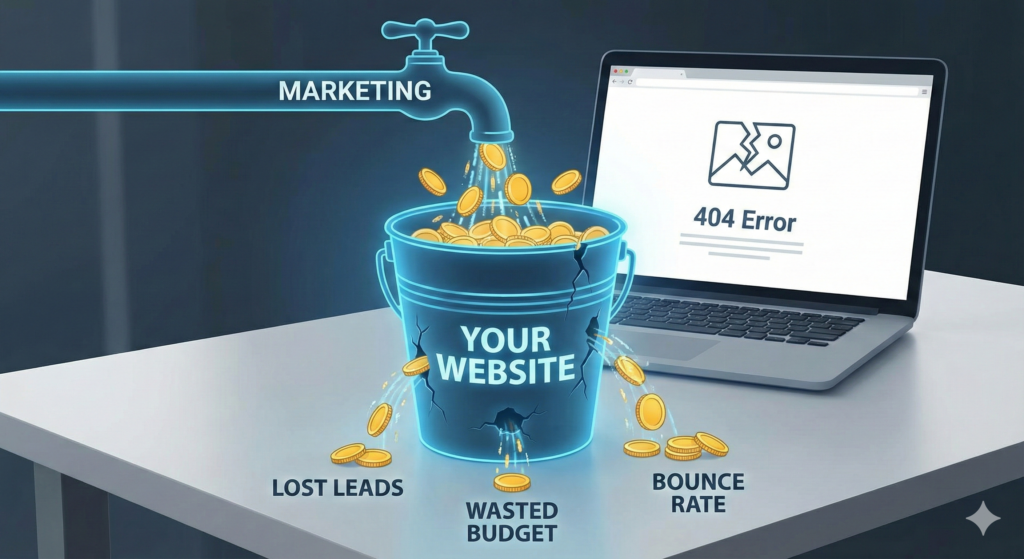
Stop Feeding the Leaky Bucket: Why Your Website Needs Fixing Before Your Marketing Will Work
It’s a frustrating scenario I see all the time: A business owner pours money into Facebook ads, hires an SEO agency to boost rankings, and posts daily on Instagram. They look at their analytics and see traffic spiking. People are clicking.
But nobody is buying. Nobody is filling out the contact form. The phone isn’t ringing.
This is the classic “leaky bucket” syndrome. You are pouring expensive water (traffic) into a bucket full of holes (your website). Before you spend another dime on advertising or content marketing, you need to patch the holes.
Here is why driving traffic to a sub-par website is the fastest way to burn through your budget, and how to fix the foundation first.
1. The First Impression Hole: Outdated Graphic Design We judge books by their covers and businesses by their websites. It takes about 0.05 seconds for a user to form an opinion about your site that determines whether they’ll stay or leave.
If your branding looks like it was made in 2010, or if your layout is cluttered and confusing, you have immediately lost trust. Great graphic design isn’t just about making things look “pretty”; it’s about organizing information intuitively and signaling professionalism. If you don’t look credible, they won’t convert.
2. The Technical Hole: Poor Performance and UX You might have the best product in the world, but if your mobile site takes 8 seconds to load, your potential customer is already looking at your competitor’s site.
Solid web development is the unseen backbone of marketing. Google knows that users hate slow, buggy websites, and they will penalize your SEO rankings for it. Furthermore, if your site isn’t perfectly responsive on mobile devices (where most traffic comes from now), you are actively blocking 60%+ of your audience from buying.
3. The Messaging Hole: Confusion is the Enemy of Conversion When a visitor lands on your homepage, can they answer these three questions within five seconds?
What do you do?
How does it help me?
What do I need to do next (the Call to Action)?
If your website is filled with jargon, vague promises, or it buries the “Contact Us” button, visitors will get frustrated and bounce. Clear design and strategic messaging must guide the user toward a single goal.
The Solution: Fix the Bucket, Then Turn on the Hose Marketing channels like SEO, social media, and paid ads are incredible tools for generating demand. But they are amplifiers. If your website is great, marketing amplifies success. If your website is broken, marketing just amplifies the flaws to more people faster.
